

If your child receives services in your home, attends school in your community, participates in recreation programs, has a job coach, receives supported living services, or has the opportunity to grow up surrounded by family instead of an institution, you have benefited from one of the most important disability rights decisions in American history.
Many parents have never heard of Olmstead v. L.C. Yet it changed nearly every aspect of how disability services are delivered today.
Now, more than 25 years later, advocates across the country are warning that those hard-fought protections could be at risk.
What Is the Olmstead Decision?
In 1999, the U.S. Supreme Court decided Olmstead v. L.C., ruling that under the Americans with Disabilities Act (ADA), people with disabilities have the right to receive services in the most integrated setting appropriate to their needs whenever community-based supports are appropriate.
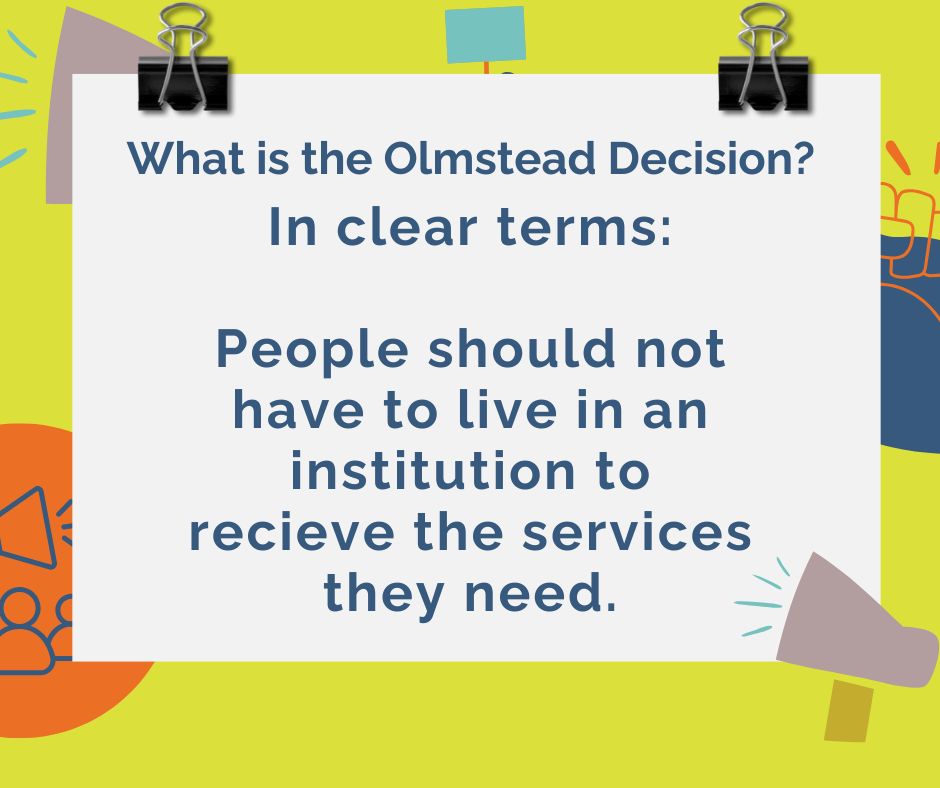
The decision recognized that unnecessary institutionalization is discrimination because it separates people with disabilities from their families, neighbors, schools, workplaces, and communities.
What Changed in Everyday Life?
Because of Olmstead, millions of people gained greater opportunities to:
-Live in their own homes or small community residences instead of large institutions.
-Attend neighborhood schools with inclusive education opportunities
-Work in competitive employment with supports.
-Receive therapies, nursing, and personal care at home.
-Stay connected to family instead of being separated by institutional placement.
For many families, this meant no longer facing the impossible choice between caring for a loved one at home without support or placing them in an institution simply because services were unavailable elsewhere.
Community living became recognized not as a privilege, but instead as a civil right.
New York’s Painful History
Long before Olmstead, thousands of children and adults with developmental disabilities lived in massive state institutions, including the infamous Willowbrook State School and Letchworth Village. Families were often told institutionalization was the only option while conditions in the facilities were heartbreaking. Overcrowding, neglect, abuse, lack of education, poor medical care, and isolation from families became tragically common. Investigations exposed conditions that shocked the nation and forced Americans to confront how people with disabilities were being treated.
The movement away from institutions began before Olmstead, fueled by courageous parents, self-advocates, journalists, attorneys, and disability rights organizations. The Olmstead decision accelerated and strengthened that movement by making community integration a protected civil right under federal law. It is so deeply important to remember that this history is not ancient history as former Willowbrook and Letchworth residents are still alive today. Many now receive services from New York disability providers. Their lives remind us how dramatically disability services have changed, and why those changes must never be taken for granted.
None of these changes happened because government simply decided to do the right thing.
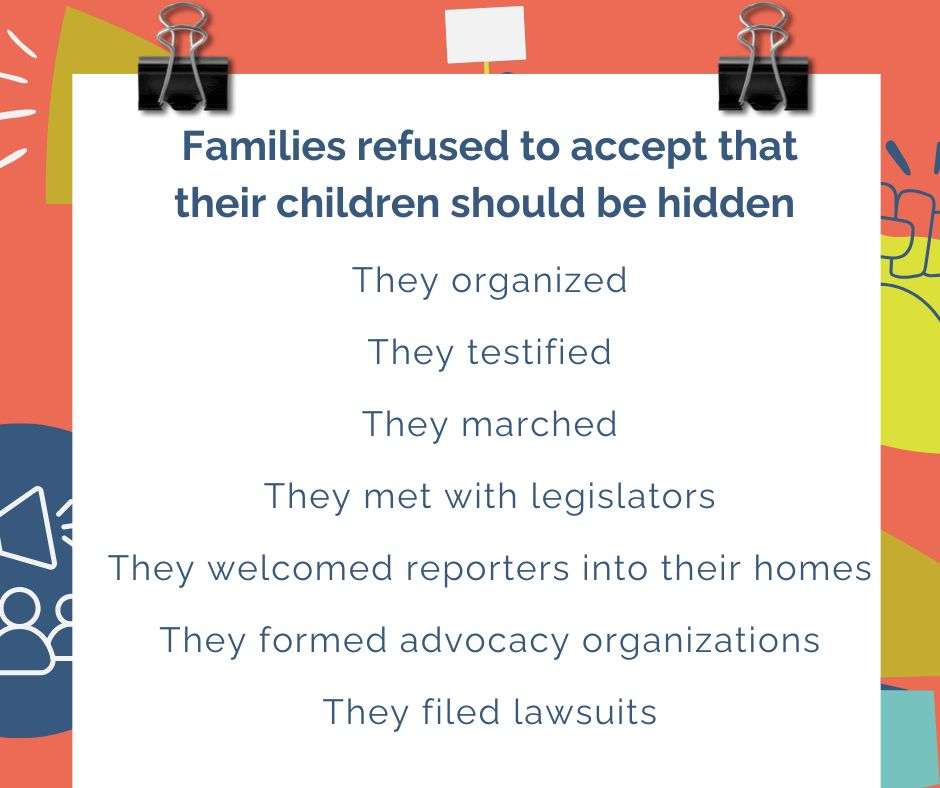
Many of the services families rely on today exist because parents before us were willing to speak up.
Why Families Are Talking About Olmstead Again
Recently, the disability community has become deeply concerned about a legal opinion issued by the U.S. Department of Justice’s Office of Legal Counsel.
The memo argues that federal disability laws do not require states to provide services in community settings in the way Olmstead has been interpreted and enforced for more than two decades. Disability organizations across the country, including the American Association of People with Disabilities, warn that this interpretation could weaken federal enforcement of community integration protections if adopted more broadly.
We are concerned because it signals a significant shift in how the federal government may interpret and enforce disability rights going forward. That could affect future litigation, enforcement actions, and public policy. We encourage every family to read the excellent summary prepared by the American Association of People with Disabilities, which explains these concerns in greater detail.
What Can New York Parents Do?
You do not need to be a lawyer or policy expert to make a difference.
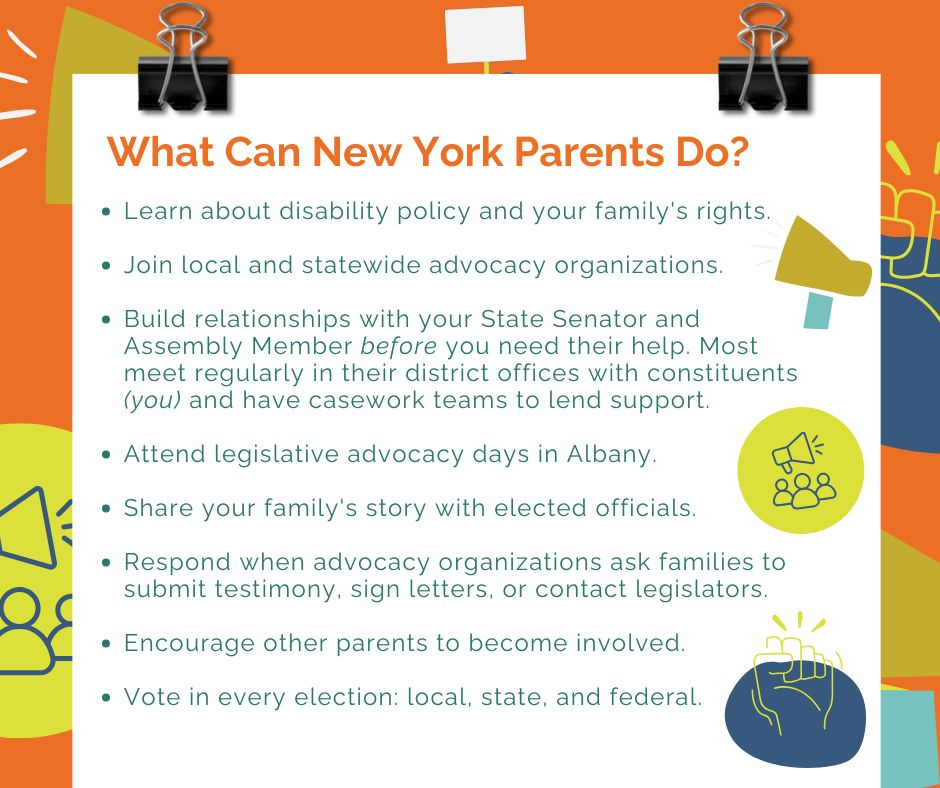
Most legislators take over 10 meetings every day that they are in legislative session, they hear lots of statistics and message points, what they remember most is personal stories. You are their constituent. Elected officials are voted in office to represent you. Your family’s experience has the power to influence public policy.
Why Olmstead Still Matters
Olmstead is about so much more than where someone lives. It requested that people with disabilities belong in our neighborhoods, our schools, our workplaces, our communities, and our lives.
For New York families, the Olmstead act and what it represents has now spanned recent generations, that is because the parents who came before us fought tirelessly to replace segregated facilities with inclusion.
Up until now we haven’t been at risk to lose the battles already won, but now it is our turn to protect that progress.
The future of disability rights never depends on one singular court case or instance.
It depends on families who know that their children deserve better, and who are willing to stand up together to make sure they received it.