For many families raising children with disabilities, the OPWDD CROW process feels overwhelming, confusing, and, at times, discouraging. Parents tell us they are waiting for months or years, not hearing back, unsure if their child is “on the list,” or afraid they missed a deadline they didn’t even know existed.
If that sounds like you, you are not alone.
This guide is here to do two things:
- Demystify the CROW process: what it is, what services you can apply for, and how it works by age.
- Empower you as an advocate : because your child’s future depends on more than paperwork. It depends on your voice.
We have come a long way in New York State. Not that long ago, families were told their only option was to institutionalize their children. Services barely existed. Advocacy built the system we have today, and advocacy is required to keep that system working.
What Is the OPWDD CROW Process?
CROW stands for Centralized OPWDD Referral and Waiting List.
It is the system New York State uses to:
- Accept referrals for OPWDD-funded services
- Track demand for services
- Match individuals to available programs when openings occur
Submitting a CROW referral is often the first formal step toward accessing OPWDD services beyond early intervention or school-based supports.
Important: Being on the CROW list does not guarantee immediate services or a clear timeline.
This is where many families feel lost, and why advocacy matters.
OPWDD Services You Can Submit For Through CROW
Young Children (Birth–5)
Before OPWDD, many children receive Early Intervention (EI) or CPSE services through the school system. However, families should still be preparing early for OPWDD if a long-term developmental disability is expected.
Services families may seek or plan for via CROW include:
- Respite Services
Short-term care to give caregivers time to rest and restore themselves
- Family Support Services
Parent training, support groups, skill-building programs
- Community Habilitation (ComHab)
1:1 support focused on daily living, communication, and social skills (often starts later in life but planning early matters)
- Future Residential Planning
Even if housing is years away, early CROW inquiries can be critical to placement
Key advocacy note:
Many parents wait “until later” to start the OPWDD process and that delay can result in years on a waitlist.
School-Age Children (6–13)
As children age out of early childhood systems, OPWDD becomes more central.
Common services families seek include:
- Respite (In-Home or Facility-Based)
- Community Habilitation
- Day Habilitation (limited for younger children)
- After-School or Weekend Programs
- Family Reimbursement & Supports
- Self-Direction (with guidance)
This is often when parents realize:
- School services are not enough
- Care needs extend beyond the classroom
- The system does not automatically “catch” your child
Teenagers & Transition-Age Youth (14–21)
Waitlists often become painfully real during transition planning.
OPWDD services often sought:
- Day Habilitation
- Prevocational & Employment Supports
- Self-Direction
- Residential Services (IRA, Supportive Housing, etc.)
- Life Skills & Community Integration Supports
Why Families Are Experiencing Long Waits
Parents tell us they feel:
- Stuck on waitlists with no updates
- Unsure if paperwork was processed correctly
- Afraid to “rock the boat” by asking questions
- Unsure who their contact even is
This happens because:
- Demand exceeds available programs
- OPWDD relies heavily on centralized tracking
- Communication can be inconsistent
- Families are expected to follow up proactively
This is not your failure.
But it’s important to know that OPWDD is a system that requires advocacy.
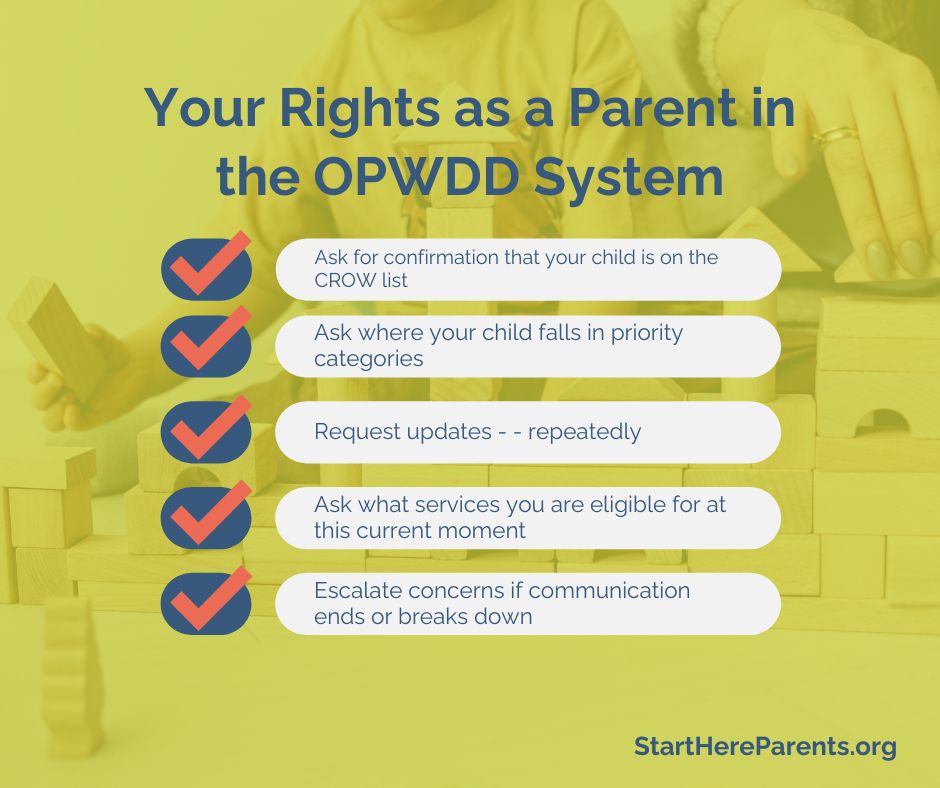
Your Rights as a Parent in the OPWDD System
You have the right to:
And yes, you have the right to go beyond OPWDD.
How to Advocate When You’re Stuck or Ignored
If OPWDD is not responding, timelines feel unreasonable, or your child’s needs are urgent:
Step 1: Document Everything
Keep records of:
- Dates
- Names
- Emails
- Referrals
- Missed responses
Step 2: Contact Your Elected Officials
Open a constituent case with:
- Your NYS Assembly Member
- Your NYS Senator
Their offices exist to help constituents navigate state agencies.
You can say:
“My child is eligible for OPWDD services and we are not receiving timely communication or support. I am requesting assistance navigating this process.”
This is not bring dramatic. This is an appropriate way to get services from someone that was elected to support you.
Step 3: Be Clear, Persistent, and Unapologetic
Your child’s future housing, safety, and independence depend on these systems.
Advocacy is not complaining, it is participation.
A Reminder for New and Young Parents
Not long ago, parents were told: “There are no services. Send your child away.” That only changed because families refused to accept shipping their children elsewhere and demanded an alternative to institutionalization. I encourage you to look into the history of the disability agency in your community and across NYS as it is very likely that the organization was created by parents out of a desire to have more opportunities for their children.
The system we have today exists because parents pushed, and it only improves when parents continue to push.
Reminders:
You do not need to be polite at the expense of your child’s needs.
You do not need to wait quietly.
You do not need to be grateful for crumbs.
You need to be informed.
And sometimes, you need to be loud.
Template Email to OPWDD
Parents, if you need more information from OPWDD, feel free to start with the template below that Start Here Parents has designed for you to customize.
Subject: Request for CROW Status Update and Service Eligibility – [Child’s Name, DOB]
Dear [OPWDD Contact Name / Front Door Office],
I am the parent/legal guardian of my child, [Child’s Full Name], date of birth [DOB]. I am writing to request a clear update regarding my child’s status within the OPWDD CENTRALIZED REFERRAL AND WAITING LIST Process.
Specifically, I am requesting confirmation of the following:
- That my child has been successfully entered into the CROW system
- The date our referral was received and processed
- The services for which my child is currently eligible
- Our current status or priority level on any applicable waiting lists
- Any additional documentation or steps needed from our family at this time
My child has ongoing support needs, and timely communication is critical to ensuring their health, safety, and development. If services are not immediately available, I am requesting guidance on interim supports and any actions we can take to prevent delays.
Please respond in writing so we may keep accurate records. If another contact or department is better suited to address this request, please advise promptly.
Thank you for your attention to this matter. I look forward to your response.
Sincerely,
[Your Full Name]
[Your Phone Number]
[Your Email Address]
[Child’s Name]
Where to Submit / Start with OPWDD : A Quick Guide
OPWDD “Front Door” – Start the Process
This is where families begin eligibility and service planning:
OPWDD Front Door Overview & Contact Info
https://opwdd.ny.gov/front-door
Contact the OPWDD Infoline at 866-946-9733 and ask them to transfer you to your local Front Door Office by telling the operator what county you live in.
The first step to receiving assistance is to determine if you are eligible. Once you are determined eligible, you can begin the planning process. There are many supports and service options available, including supports to live in your home independently or with others, employment, day habilitation, and children’s services.
The full service guide is available in multiple languages here.
Tip for parents: Always ask for written confirmation that your referral was received and entered into the system.
How to Find Your NYS Assembly Member & State Senator
(For opening a constituent case when OPWDD is unresponsive)
Find Your NYS Assembly Member
https://nyassembly.gov/mem/search
Find Your NYS State Senator
https://www.nysenate.gov/find-my-senator
Once you find your representative, look for a section called “Services,” “Constituent Services,” or “Help with a State Agency.”
You can request help by saying:
“I am a constituent seeking assistance navigating OPWDD services for my child with disabilities.” You can submit an email to the general inbox, call the office, or request and in-person meeting either at their Albany office in the NYS Capitol or in their district office which will likely be within driving distance of your home.
OPWDD Advocacy Checklist for Parents
Before & During CROW Submission
☐ Confirm OPWDD eligibility or Front Door appointment
☐ Submit referral and request written confirmation
☐ Ask what services you should apply for now and later
☐ Keep copies of all paperwork
Documentation to Keep
☐ Medical and diagnostic records
☐ School IEP / CPSE / EI documentation
☐ Emails and letters from OPWDD
☐ Dates, names, and summaries of phone calls
While Waiting
☐ Follow up every 60–90 days (minimum)
☐ Ask about priority categories and interim supports
☐ Document lack of response or delays
If You Are Stuck or Ignored
☐ Email OPWDD requesting written clarification
☐ Escalate to a supervisor or regional office
☐ Open a constituent case with Assembly & Senate offices
☐ Bring documentation and timelines
Advocacy Mindset
☐ Be clear, not apologetic
☐ Be persistent, not passive
☐ Remember: silence is not an answer
You can do this.
You are not asking for favors.
You are exercising your child’s rights.
The OPWDD system exists because parents before you demanded better.